
The lost trades of Romagna
Jobs that made Romagna and almost disappeared within a few decades. For each one we tell you what it was like, where you can still see its traces and where the facts come from.
01The marshes around Ravenna
The scariolanti, labourers of the marshes
Wheelbarrow, shovel and feet in the mud. The scariolanti were the day labourers who, by sheer strength, dug canals, raised embankments and drained the marshes of the Romagna lowlands. They were hired by the day, called week by week, with malaria always close.
In 1883 the Associazione Generale degli Operai Braccianti was founded in Ravenna, one of the first labour cooperatives in Italy. On 24 November 1884 a few hundred of them left Ravenna station by train, led by Nullo Baldini and Armando Armuzzi, to drain the marshes of Ostia, at the gates of Rome.
Ostia still remembers them with the Parco XXV Novembre 1884 and a ceremony every year. A folk song has also survived, «Gli scariolanti», born in the reclamation works of Romagna.
Sources: L'Espresso, «L'epopea dei romagnoli, i braccianti socialisti che bonificarono Ostia antica», 24 ottobre 2022 · Turismo Roma, «Parco XXV Novembre 1884» · Il Deposito, «Gli scariolanti»

02The pine forests of Ravenna
The pinaroli, pine nut gatherers
For centuries the pine forests of Ravenna belonged to the abbeys: in the 16th and 17th centuries people could only graze their animals and gather firewood there, while the cones and pine nuts belonged to the monks. In 1588 Pope Sixtus V called the forest «the ornament of all Italy» and banned felling. In 1774 the historian Francesco Ginanni wrote that it yielded about 60 tonnes of pine nuts a year, sold as «pinocchi di Ravenna».
They were gathered by the pinaroli, teams of young men and sometimes girls, at work from autumn to spring. Some climbed to the top of the pines with long poles fitted with an iron hook: they bent the branches, knocked the cones down and swung from one tree to the next. The others picked them up from the ground and carried them in sacks and carts to the Case delle Aie, where they were heaped until they opened and released the nuts. The pinaroli slept there too.
It was hard and dangerous work, and it lasted until the early 20th century. Ravenna has named a roundabout after the pinaroli, but few people know who they were.
Sources: Il Romagnolo, Silvia Togni, «I pinaroli del ravennate», 25 novembre 2022 · Comune di Ravenna, «Pineta di Classe»

03The lowland countryside
The hemp workers
Until the 1950s hemp was the heart of the farming economy of Emilia-Romagna: it gave work to whole families and shaped the landscape. For hemp, Italy was second in the world only to Russia.
It was sown in February and March and cut in summer. Then the bundles went into the macero, the water pond that almost every farm had near the house: they were held under water with big river stones until the fibre came away from the wood. It was the hardest and smelliest job of the year. The fibre became ropes, sacks and the linen of bridal trousseaus.
With synthetic fibres hemp vanished within a few years. What remains are the maceri, now ponds full of frogs and herons, and the looms in the attics of farmhouses.
Sources: Geotema n. 35-36, AGeI, Pistocchi, la canapa in Emilia-Romagna · Regione Emilia-Romagna, patrimonio culturale, attrezzi della canapa

04Lugo
The washerwomen
Before the washing machine, the laundry of well-off families was done by washerwomen. In Lugo it began in the courtyards of the houses in the centre: water was heated in a cauldron on the «furnasela», the little stove, and lye was added, water filtered through ash that loosened the dirt.
Then the linen travelled on carts and wheelbarrows to the Canale dei Mulini, dug from 1389 onwards. There stands the Ponte delle Lavandaie, the «pont da bugadéri», from the 17th century: from its steps, which go down to the water, the women rinsed the clothes and spread them to dry on the banks. Washing was done this way until the 1950s; in the 1960s washing machines arrived and the trade ended.
In 2025 the volunteer readers of the Lugo library collected the voices of the last three washerwomen, all in their nineties, Giancarla Salvadori, Laura Ricci in Fontanieri and Giuseppina Tugnoli, in the booklet «Il Ponte delle lavandaie di Lugo, ossia il mestiere del bucato».
Sources: Romagna Notizie, le testimonianze delle ultime lavandaie di Lugo, 13 gennaio 2025 · FAI, I Luoghi del Cuore, «Ponte delle Lavandaie, Canale dei Mulini»

05Brisighella and the Sillaro
The carters
Before lorries, almost everything travelled on the biroccio: two wooden wheels up to 1.70 metres high, two shafts and a horse, which pulled between 900 and 1,300 kilos. The barrocciai, or birocciai, left at dawn and came back late in the evening. They usually had two horses, each with its own name, and looked after them with great care.
Along the Sillaro, between Imola and Castel San Pietro, they carried gravel and sand from the river, bricks and lime from the kilns, grapes and must for the taverns of Bologna, sugar beet, hemp, firewood and house moves. In Brisighella they hauled gypsum from the quarries near the town, and their donkeys were sheltered in the Via degli Asini, the covered, raised street of the centre.
After the war, reconstruction wanted bigger and faster vehicles: the young carters took their lorry licence and became hauliers. By 1975 very few were left. The last one on the Sillaro, Marino Gnugnoli, drove his biroccio until the early 1980s, at over eighty.
Sources: Terra Storia Memoria, «I birocciai», Castel San Pietro Terme · Italia.it, «Brisighella»

06Perticara, Valmarecchia
The sulphur miners
Beneath the houses of Perticara lies a hidden city: more than a hundred kilometres of tunnels on nine levels. It was the sulphur mine, one of the largest in Europe. In 1938 more than 1,600 people worked there and almost 50,000 tonnes of raw sulphur came out every year.
Every day the miners went down into the heat and the dust, lamps in hand. Foreign sulphur was cheaper and the seams were running out: the mine closed in 1964, the tunnels were sealed and many families had to leave.
Since 2002 the old mine site has been the Sulphur museum: the power station, the lamp room where the miners collected their lamps, the workshops and a reconstructed tunnel. Above the village the Vittoria shaft still stands.
Sulphur, Museo Storico Minerario di Perticara Lost trades of Romagna: sulphur miners, printers, sailors and salt workers Discover Novafeltria

07Santarcangelo and Gambettola
The cloth printers
Tablecloths, curtains, the blankets of the oxen: in farmhouses cloth was decorated with hand-carved pear wood blocks, dipped in a rust-coloured dye and beaten onto the fabric with a mallet. Bunches of grapes, roosters, pomegranates, the caveja. A 17th-century craft that survives today in very few workshops.
In Santarcangelo the Stamperia Marchi keeps its mangano, a huge wooden machine with a great wheel that presses, stretches and smooths the cloth before printing: according to the records it started working on 17 March 1633 and it still turns. Today the workshop is run by the siblings Gabriele and Lara Marchi.
In Gambettola there are two print shops. Pascucci has been printing since 1826, seven generations in the same workshop. Bertozzi was founded in 1920: Luigi Bertozzi was a carpenter who carved his own blocks; in the 1930s he took Romagna prints to the Milan Triennale. Today his grandson Gianluigi runs it.
Stamperia Artigiana Marchi Lost trades of Romagna: sulphur miners, printers, sailors and salt workers Discover Santarcangelo di Romagna
Sources: La Piazza Rimini, «Il mangano dell'antica stamperia Marchi compie 390 anni», 2023 · Artribune, «Artigianato resistente», i 200 anni della Stamperia Pascucci · Fondazione Cologni dei Mestieri d'Arte, intervista a Gianluigi Bertozzi

08Cesenatico
The sailors of the lug sails
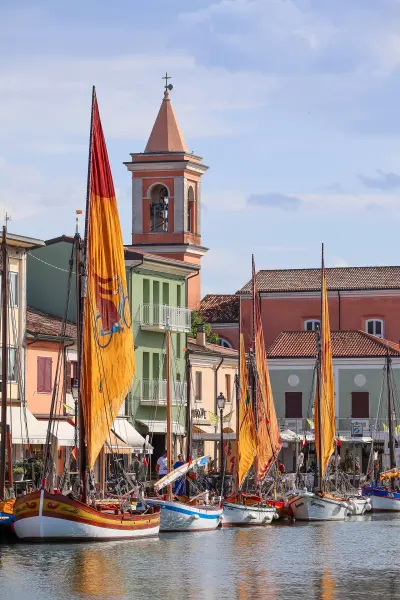
From the 18th century to the mid-20th, the fishing and small cargo boats of the Adriatic sailed with the vela al terzo, a trapezoid lug sail hoisted across the mast. The sails were coloured red, yellow and orange and bore the family emblem: from the shore you could tell at once who was coming home.
With the engine the sails disappeared. They were saved by the Museo della Marineria of Cesenatico, which keeps the historic boats afloat in the oldest stretch of the canal harbour, the one drawn by Leonardo da Vinci in 1502, and raises their sails in summer.
In 2023 the Ministry of Culture recognised lug sail navigation on the Romagna coast as cultural heritage, together with three of the museum's boats (the trabaccolo Barchèt, the bragozzo San Nicolò and the battana Vanessa) and the eyes painted on the bow that protected the fishermen.
Museo della Marineria Lost trades of Romagna: sulphur miners, printers, sailors and salt workers Sea and salt trades: Cesenatico and Cervia Discover Cesenatico
Sources: Ministero della Cultura, la vela al terzo patrimonio culturale, 2023 · Visit Cesenatico, i musei: il Museo della Marineria

09Cervia
The salt workers
Cervia was born from salt. Before 1959 the salt works were divided into about one hundred and fifty small salt pans, each worked by a family: in summer the salt was gathered by hand with wooden tools and taken to the big warehouses on the canal harbour.
Then the salt works became a single large plant and the salt workers disappeared. Only one pan is left as it was, the Salina Camillone. Since 1989 it has been looked after by the volunteers of the Civiltà Salinara association, founded by former salt workers, who harvest the salt with the method called «alla cervese» because in Italy it was used only here.
The result is the «sale dolce», sweet salt, a whole salt low in bitter salts, today a Slow Food Presidium.
MUSA Museo del Sale Lost trades of Romagna: sulphur miners, printers, sailors and salt workers Sea and salt trades: Cesenatico and Cervia Discover Cervia
Sources: Comune di Cervia, «Salina Camillone» · Fondazione Slow Food, Presidio del sale marino artigianale di Cervia

10All over Romagna
The smiths of the caveja
The caveja was the iron pin that kept the oxen's yoke fastened to the shaft of the cart: going downhill it stopped the cart from sliding onto the animals. At the top the smiths forged a small masterpiece on the anvil, the «pagella», with roosters, doves, crosses, the sun and the moon, and hung rings on it that jingled at every step.
That sound had powers: with the caveja and certain words people drove away storms and protected the harvest. In Holy Week the rings were tied, as was done with church bells.
The oxen and the carts are gone, the caveja has remained: it has become a lucky charm and the symbol of Romagna.
Sources: Wikipedia, «Caveja» · Regione Emilia-Romagna, patrimonio culturale, scheda di una caveja

Go and see them
Four of these trades can be met in a single day: the mine of Perticara, the print shop of Santarcangelo, the sails of Cesenatico and the salt of Cervia. The programme has the times from where you are staying.
-
-

Facts checked on 24 October 2026 against the sources listed under each trade: newspapers, museums, town councils, the Region, the Ministry of Culture. The full story, in Italian, is also on Passione Turismo. Curiosities and legends · Crafts · History
Want to see these places for real?
From Perticara to Cervia, from Brisighella to the pine forest of Classe: a private transfer takes you to the places of the trades and back to your hotel.
Is something missing, or would you like to add some information? Tell us.
Have you found a mistake or something not quite right? Let us know.