
Viewpoints of Romagna
17 places from which you can see all of Romagna: towers and fortresses on the hills, Apennine peaks, villages above the sea. For each one we tell you what you see and when to go, at what time of day and in which season.
- Hills and Apennines
- Valmarecchia, Valconca and San Marino
- By the sea
- Bologna, a step away
Which season are you going in?
At what time of day?
No viewpoint with these filters: try changing one.
No viewpoint with these filters: try changing one.
Hills and Apennines
Between Faenza, Forlì and the Vena del Gesso, up to the ridges of the Foreste Casentinesi.
 Photo: Marco Campanacci, CC BY-SA 4.0, Wikimedia Commons
Torre di Oriolo
Oriolo dei Fichi, Faenza
A 15th-century hexagonal tower among the vineyards of the Faenza hills. From the terrace at the top, up a sandstone spiral staircase, on clear days you see Faenza, Forlì and Ravenna, the coast from Mirabilandia to Cesenatico, the hill of Bertinoro and the peaks of the Apennines.
When to go
At sunset, when the sun goes down behind the Apennines and the vineyards light up. It is at its best in autumn, with the grape harvest and the red leaves; the terrace is open on the tower's opening days.
 Photo: Baccolini, CC BY-SA 4.0, Wikimedia Commons
Il Balcone di Romagna
Bertinoro, piazza della Libertà
Piazza della Libertà is a natural terrace over the plain: this is why Bertinoro is called the Balcony of Romagna. The view runs down the hills to the sea; on the clearest days you can make out the skyscraper of Cesenatico. The Column of Hospitality also stands in the square.
When to go
At sunset and then in the evening, when the lights of the plain and the coast come on. Winter days after the wind are the clearest: that is when the sea shows best.
 Photo: Dadonene89, CC BY-SA 4.0, Wikimedia Commons
Monte Mauro
Riolo Terme e Brisighella · 515 m
At 515 metres it is the highest peak of the Vena del Gesso Romagnola. From the top the view turns all the way round: the Senio and Sintria valleys, the Apennines and, towards the sea, the tall buildings of Milano Marittima and Cesenatico. The last 600 metres of road are gravel; from the car park you walk up for more than a kilometre to the parish church of Santa Maria in Tiberiaco.
When to go
In the late afternoon, to see the sunset turn the gypsum ridge pink. In spring everything is in flower, in autumn the air is clearer; in summer go early, there is little shade.
 Photo: Federiscio, CC BY-SA 4.0, Wikimedia Commons
Torre dell'Orologio e Rocca
Brisighella
On the three gypsum hills above the village stand the Rocca Manfrediana, the Clock Tower and the Monticino sanctuary. From the tower you look over the village, the gypsum ridge and the badlands, the Lamone valley and the hills of olive trees and vineyards. Its clock, from 1850, has a dial of only 6 hours.
When to go
An hour before sunset, when the low light carves out the badlands. The village is at its best in autumn, with the olives and the new oil; you walk up from the centre or park at the foot of the fortress.
 Photo: Vanni Lazzari, CC BY-SA 4.0, Wikimedia Commons
Rocca di Riolo
Riolo Terme
A 14th-century fortress in the centre of the spa town, enlarged under Caterina Sforza; today it houses the Museum of the Landscape of the Faenza Apennines. From the top you look over the Faenza hills and the badlands.
When to go
By day, during the museum's opening hours. In spring the hills are bright green, in autumn they change colour; pair it with a visit to the spa or to Monte Mauro, a few kilometres away.
 Photo: Cinzia Sartoni, CC BY-SA 4.0, Wikimedia Commons
Monte Battaglia
Casola Valsenio · 715 m
At 715 metres, on the ridge between the Senio and Santerno valleys, stand the ruins of a medieval tower that once watched over Imola, Faenza and the Apennines. In 1944 one of the battles of the Gothic Line was fought here, remembered by a monument. You get there on foot, entry is free.
When to go
At sunrise or sunset, with the valleys in shadow and the ridge lit up. In autumn and on haze-free winter days the eye reaches furthest; wear hiking shoes.
 Photo: Elwhajeff, CC BY-SA 3.0, Wikimedia Commons
Monte Falco
Campigna, Santa Sofia · 1.657 m
At 1657 metres it is the highest peak of the Foreste Casentinesi National Park, a balcony over the Casentino and Romagna. You climb from Passo della Calla on the ridge trail 00, past the Burraia meadows, through ancient beech forests.
When to go
At sunrise, when the valleys below are full of mist and the ridges rise one behind the other. In October the beech forests turn red and gold; in summer it is the coolest place in Romagna. In winter there is snow: only with proper gear.
Valmarecchia, Valconca and San Marino
Malatesta fortresses and sheer cliffs inland from Rimini, with the sea always on the horizon.
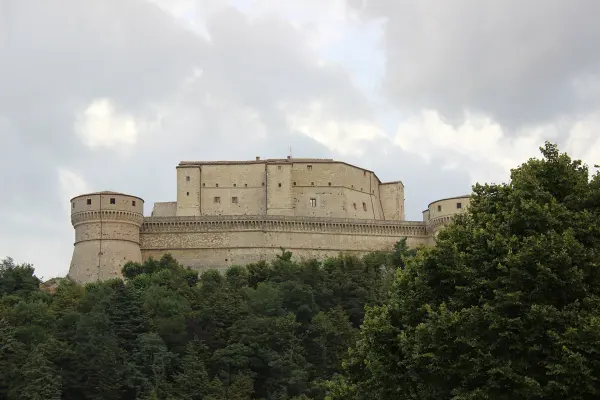 Photo: Tulumnes, CC BY-SA 4.0, Wikimedia Commons
San Leo e i Balconi di Piero
San Leo
The fortress stands on top of a sheer rock and looks over the whole Montefeltro. Just outside the village, on the ridge of Monte Gregorio towards Tausano, are two of the Balconies of Piero: the spots, identified in 2007, from which you see the landscapes Piero della Francesca painted behind the Portrait of Battista Sforza and the Saint Jerome.
When to go
At dawn on an autumn or winter morning, when the fog fills the valley and the rock looks like an island. The village viewpoint is always open, the fortress has its own hours.
 Photo: Terragio67, CC BY-SA 4.0, Wikimedia Commons
Le Tre Torri del Monte Titano
San Marino · 739 m
The three towers stand in a row on the crest of Monte Titano, at 739 metres, and you reach them on foot from the old town, also along the Passo delle Streghe between the First and the Second Tower. On one side the view drops to the Riviera and the sea, on the other to the Montefeltro and the Apennines.
When to go
At sunset, with the sun going down over the Apennines and the coast lighting up. Clear winter days are the best; in summer, if you can, avoid the middle of the day, when it is busier and hazier.
 Photo: Giacomozanni, CC BY-SA 3.0, Wikimedia Commons
Rocca Malatestiana di Verucchio
Verucchio
The Rocca Malatestiana, called "del Sasso", stands on the rock spur above the town, the cradle of the Malatesta family. From the top you look down the Marecchia valley towards Rimini, the coast and, on the other side, San Marino and San Leo.
When to go
At sunset, when the valley takes on colour and the river glitters. In spring and autumn the air is cleaner than in summer; the fortress has its own hours, the village around it is always open.
 Photo: Carlo Pelagalli, CC BY-SA 3.0, Wikimedia Commons
Castello di Montebello
Poggio Torriana
The castle stands on a cliff above the Valmarecchia and has belonged to the Guidi di Bagno counts since 1463. It can only be visited with a guide, by day and in the evening; it is famous for the legend of Azzurrina. Montebello is also one of the Balconies of Piero, linked to the Portrait of Battista Sforza.
When to go
In the afternoon, to have the valley with the sun behind you, then stay for the sunset. In autumn the woods around change colour; the evening guided tour joins view and legend.
 Photo: Diego Baglieri, CC BY-SA 4.0, Wikimedia Commons
Rocca di Montefiore Conca
Montefiore Conca · 385 m
The square bulk of the fortress, a residence of the Malatesta, can be seen from the sea and rules over the Conca valley from its 385-metre hill. Inside there are 14th-century frescoes; from the top you see the whole Riviera, from Cesenatico to Pesaro, and the Apennines of the Marche.
When to go
At sunset, with the coast lighting up below you. In spring and autumn the view of the sea is sharper; the fortress has its own opening hours.
By the sea
The Riviera seen from above and the salt pans at sunset.
 Photo: Toni Pecoraro, pubblico dominio, Wikimedia Commons
Misano Monte
Misano Adriatico · 97 m
The old village of Misano Adriatico, on the hill about 97 metres up behind the coast, with the church of San Biagio at the top. From its edges the view runs down over fields and olive trees to the sea and the Riviera, with San Bartolo and Gabicce to the south.
When to go
On a summer evening, when the coast is a string of lights; or at sunrise, with the sun rising from the sea. In winter the air is clearer and you see further.
 Photo: Enrico Siboni, CC BY-SA 3.0, Wikimedia Commons
Gabicce Monte
Gabicce Mare · 150 m
The village stands at about 150 metres on the San Bartolo headland, just over the border with the Marche. From the square and the viewpoint you see Gabicce Mare from above with the whole Romagna coast; on the clearest days the sea opens up to the horizon. You get there by car on the Panoramica road.
When to go
At sunset, when the sun goes down behind the hills and the coast turns gold; then stay for the evening lights. In spring the Panoramica road in flower is beautiful, in summer it is the most sought-after sunset of the coast.
 Photo: Franca Cecchinato56, CC BY-SA 4.0, Wikimedia Commons
Saline di Cervia
Cervia
It is not high up, but it is one of the most beautiful sunsets in Romagna: 827 hectares and more than 50 basins of water inside the Po Delta Park, where the sweet salt of Cervia is made and pink flamingos live. It is a nature reserve: you go in with the guides of the Visitor Centre, on foot, by bike or by electric boat.
When to go
At sunset, when the basins mirror the orange sky and the flamingos become silhouettes. Guided visits leave from the Visitor Centre from March to November: book and ask for the one that ends at sunset.
Bologna, a step away
It is not Romagna, but it is close: the city of porticoes from its hills.
 Photo: Gianni Careddu, CC BY-SA 4.0, Wikimedia Commons
La terrazza della cupola di San Luca
Bologna
The sanctuary stands on the Colle della Guardia, at the top of the longest portico in the world (about 3.5 km and 666 arches from Porta Saragozza). Since 2017 you can climb inside the dome to the panoramic terrace, 42 metres up: a 180-degree view over Bologna, the hills and the plain.
When to go
In the late afternoon, walking up under the portico, to reach the terrace in the sunset light. On the clearest winter days you can sometimes see the Alps on the horizon; the terrace has its own hours.
 Photo: Lorenzov79, CC BY-SA 4.0, Wikimedia Commons
Piazzale di San Michele in Bosco
Bologna
On the hill above Porta San Mamolo, the square in front of the church of San Michele in Bosco looks over the whole of Bologna: the red-roofed old town, the towers, the plain. The old monastery now houses the Rizzoli Orthopaedic Institute.
When to go
At sunset, when the roofs turn a bright brick colour, and then in the evening with the city lit up. In winter and spring, on windy days, the view is sharper.
For a perfect view
Pick the day after the wind
The longest views come after a day of wind or rain, when the air is clean: that is when you see the sea from the hills and, from Bologna, sometimes even the Alps.
Summer means haze
In the heat the horizon blurs and the sea vanishes into the haze. In summer go for the first hours of the morning or for sunset, when the light makes up for it.
The sea of fog
In autumn and winter the valleys often fill with fog while the peaks stay in the sun. Go up the highest rocks early, like San Leo or Monte Falco: it is the rarest show.
Careful near the edges
Cliffs, badlands and gypsum ridges do not always have a railing: stay on the marked paths, keep children close and bring suitable shoes, a jacket and a torch if you stay after sunset.
Towers, fortresses and terraces have hours that change with the season: check them on the official page before you leave. The moment and the season are our advice. Check tomorrow's weather
At sunset, without thinking about the road
Hill roads, evening and darkness on the way back: with Romagna Transfer we take you there and bring you back to your hotel.