
War and remembrance in Romagna
A land of borders and passage, Romagna has seen armies for two thousand years: Romans, Goths, Byzantines, lords at war with each other, popes, Napoleon. In 1944-45 the front of the Gothic Line stopped here for eight months. Here are 59 places to understand, remember and visit with respect.
- Timeline of the wars in Romagna 21
- The Gothic Line 5
- Bunkers and fortifications 4
- War and weapons museums 9
- War cemeteries and memorials 13
- The places of the massacres 11
- Imprisonment and internment 4
- Trails, ridges and strongholds 6
- Fallen aircraft and unexploded bombs 3
- At sea: wrecks and attacks 4
- Why it is called Rio Sanguinario
- The art of reuse
- Warning: unexploded bombs
- The Gothic Line
- Bunkers and fortifications
- War and weapons museums
- War cemeteries and memorials
- The places of the massacres
- Imprisonment and internment
- Trails, ridges and strongholds
- Fallen aircraft and unexploded bombs
- At sea: wrecks and attacks
No place found: try another word.
Timeline of the wars in Romagna
Battles on land and at sea, invaders and wars between neighbouring towns: the main steps, from 82 BC to the Liberation.
-
82 BC
The battle of Faventia
In the civil war between Marius and Sulla, near Faenza Sulla's army led by Metellus Pius defeats the Marian consuls Carbo and Norbanus.
-
49 BC
Caesar crosses the Rubicon
Crossing the border of Roman Italy under arms is a declaration of war on Rome: the civil war begins.
-
538
The Goths besiege Rimini
In the war between Goths and Byzantines King Witiges besieges Rimini, defended by Justinian's troops; two years later Belisarius enters Ravenna.
-
1003 - 1138
The battles of the Rio Sanguinario
Between Imola and Castel Bolognese the towns clash again and again: Imola against Ravenna, Forlì and Faenza in 1003, Ravenna against Faenza in 1134, Faenza and Bologna against Imola and Ravenna in 1138. The stream's name comes, tradition says, from that blood.
-
1240 - 1241
Frederick II besieges Faenza
The emperor besieges the Guelph town for months, until Faenza surrenders in the spring of 1241.
-
1275
The battle of the San Procolo bridge
Near Faenza the Ghibellines of Romagna led by Guido da Montefeltro rout the Guelph army of Bologna and its allies.
-
1 May 1282
The "bloody heap" of Forlì
Guido da Montefeltro defends Forlì from the French army sent by the pope and destroys it: Dante recalls it in the Inferno, "e di Franceschi sanguinoso mucchio".
-
1377
The massacre of Cesena
In February the Breton mercenaries serving Cardinal Robert of Geneva, the papal legate, massacre thousands of the town's inhabitants.
-
1499 - 1500
Caterina Sforza against Cesare Borgia
The lady of Forlì and Imola holds out in the Ravaldino fortress against Valentino's army, which takes it in January 1500; the next year Faenza falls too.
-
11 April 1512
The battle of Ravenna
On Easter Sunday, along the Ronco, the French and the Duke of Ferrara defeat the army of the Holy League in one of the bloodiest battles of the century; the French commander Gaston de Foix is killed. The place is marked by the Colonna dei Francesi.
-
15th - 18th c.
The impregnable fortress of San Leo
Redesigned in the 15th century for the Montefeltro, the fortress on the rock later becomes the pope's prison.
-
2 February 1797
The battle of the Senio
Napoleon's troops defeat the papal army on the Senio, near Faenza, and enter Romagna: the rule of the popes ends.
-
25 March 1831
The Celle clash at Rimini
During the uprisings of 1831 General Carlo Zucchi's volunteers face the Austrians at the gates of Rimini before withdrawing.
-
24 May 1915
The Great War comes from the sea
The day after Italy enters the war the Austro-Hungarian fleet shells the coast: the cruiser Sankt Georg hits Rimini.
-
1915 - 1918
Francesco Baracca, the ace from Lugo
The pilot from Romagna scores 34 victories and dies on the Montello in June 1918; his prancing horse will become the symbol of Ferrari.
-
August - September 1944
The attack on the Gothic Line
The Allies break through at Montegridolfo on 31 August, fight for days at Gemmano and Coriano and free Rimini on 21 September.
-
27 September - 11 October 1944
Monte Battaglia
Partisans, Americans and British hold the mountain against German counter-attacks in one of the hardest battles of the Apennines.
-
October - December 1944
The towns freed
Cesena on 20 October, Forlì on 9 November, Ravenna on 4 December with the partisans, Faenza on 17 December with the New Zealanders. Then the front stops on the Senio.
-
1944
San Marino, refuge for 100,000 people
The small neutral Republic takes in the displaced from Romagna and the Marche, even in the railway tunnels.
-
April 1945
The spring offensive
On 9 April the Allies cross the Senio; within days Lugo, the Bassa Romagna and Imola (14 April) are freed. Bologna is free on 21 April, the war in Italy ends on the 25th.
-
1945 - 1969
The war cemeteries
From 1945 the Allied cemeteries of Romagna are laid out; in 1969 the great German cemetery opens at the Futa Pass.
Ancient and medieval dates come from the chronicles of the time and may vary between historians. The history of Romagna
Why it is called Rio Sanguinario
The Rio Sanguinario is the stream that marks the border between Castel Bolognese and Imola, and so between the provinces of Ravenna and Bologna. It rises from small ditches between Pediano and Mazzolano, runs between Bergullo and La Serra, passes under the Via Emilia at La Torretta and flows into the Santerno.
Precisely because it is a border, the armies of neighbouring towns clashed here for centuries. The name, "bloody", comes by tradition from a battle in 1138 between Faenza and Bologna on one side and Imola and Ravenna on the other, when the water of the stream is said to have turned red. Other explanations: the reddish soil that colours the water after heavy rain, or the blood of Christian martyrs, as Monsignor Lanzoni wrote in 1918.
In the stream bed there are also the "buldur", small cold mud volcanoes about twenty centimetres high that bubble methane: their mud is used at the Riolo spa. From September 2026 to May 2027 the Via Emilia bridge over the stream is under works, with alternating one-way traffic.
- 82 BC Marius against Sulla, in the Roman civil war.
- 1003 the militia of Imola against Ravenna, Forlì and Faenza.
- 1134 Ravenna against Faenza.
- 1138 Faenza and Bologna against Imola and Ravenna: the battle that, by tradition, gave the stream its name.
- 1403 Milan against Bologna.
- 1434 Milan against the pope's troops.
Source: Paolo Grandi, "The waterways of Castel Bolognese" (castelbolognese.org), quoting a manuscript of the town library. The story is also in our curiosities: The Rio Sanguinario
The Gothic Line
The places where the 1944 front ran: ridges, destroyed villages, churches of peace.
The Gothic Line was the German defence system built to stop the Allied advance in Italy: more than 300 kilometres from Massa to Pesaro, along the Apennine ridges down to the sea, with minefields, barbed wire, anti-tank ditches, trenches and bunkers. The Todt organisation built it from 1943, often with labour taken on the spot.
The Allied attack on the Adriatic side began at the end of August 1944: Montegridolfo, Gemmano, Coriano, Rimini freed on 21 September. Then rain and flooded rivers slowed everything down: the front stayed still on the Senio and the Apennines all winter, until the offensive of April 1945.

Monte Battaglia
Casola Valsenio
On the ridge between the Senio and Santerno valleys, at 715 metres, stand the ruins of a medieval fortress. From 27 September to 11 October 1944 a very hard positional battle was fought here, with thousands of dead, missing and wounded: partisans of the 36th Bianconcini brigade, Americans of the 350th "Blue Devils" regiment and the British First Guards Brigade against the Germans. On the top stands the bronze monument by Aldo Rontini; on the slopes the trenches can still be seen.
When and how to see it
Always open, free access. The last stretch is on foot: wear hiking shoes. From the top the view sweeps over both valleys.
Source and information In the castles Viewpoint Discover Casola Valsenio

Gemmano e Farneto
Gemmano
The village was razed to the ground in the fighting between 4 and 15 September 1944, when the Allies entered it. At the former church of Farneto a plaque recalls 7 September 1944, when Father Antonio Marcaccini stood in the way to defend six young men sentenced to death. The town's multimedia museum has a section on the Gothic Line.
When and how to see it
The village and the Farneto plaque can always be seen. The Path of Remembrance starts here (see Trails) and the Onferno caves are a few kilometres away.
Montegridolfo e i rifugi nel tufo
Montegridolfo
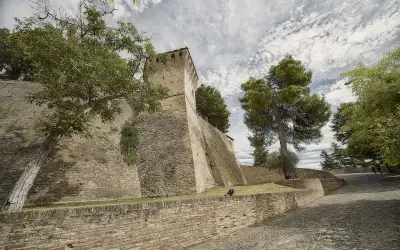
It was the first hill stronghold of the Green Line 1 freed by the Allies, on the evening of 31 August 1944. Below the castle walls the Museum of the Goths' Line has been open since 2002, with weapons, posters, newspapers and films of the time; from its path you see the point where the German defence was broken. In summer 1944 the villagers dug their shelters into the tuff: 11 have been found, named after the families who dug them.
When and how to see it
The village can always be visited; the museum has seasonal and special openings (for example the European Night of Museums): check its site before you go.
Source and information In the museums Discover Montegridolfo

Trarivi e la Chiesa della Pace
Montescudo-Monte Colombo
On the hill of Trarivi, during the second battle of Coriano, the British attacked with 45 tanks. The old church, hit by the bombing, has been restored since 1989 as the Church of Peace: inside hangs the Bell of Peace, given in 1991 by the veterans. In the rectory the Museum of the Eastern Gothic Line keeps photographs, finds and newspapers.
When and how to see it
The museum opens on Saturday and Sunday afternoons, free entry, no booking; the hours differ between sources, better call first.
Source and information In the museums Discover Montescudo-Monte Colombo

Isola degli Spinaroni
Ravenna, Pialassa della Baiona
An island in the Pialassa della Baiona lagoon, north of Ravenna, reached only by boat: in 1944 it was the base camp of the partisans of the "Terzo Lori" valley detachment, with hundreds of fighters and a radio station. From here, on the night of 3 to 4 December 1944, Operation Teodora set off and opened the way to the liberation of Ravenna. A rebuilt hut, a plaque and the trenches remain.
When and how to see it
It can only be reached by boat, usually during commemorations and organised trips in the Po Delta Park: ask the Ravenna tourist office.


Bunkers and fortifications
The coast fortified by the Germans and the shelters dug by the people: where they are and when you can see them.
Visit Bunker 360, Milano Marittima
Cervia
Digging for the new seafront of Milano Marittima brought back to light the German bunkers built to defend the coast from a landing: two Tobruks with walls over a metre thick and a turret for one man, a Regelbau 668 for communications with a line by the poet Schiller painted on the wall, and a large Regelbau shelter furnished with original objects. Along the beach the dragon's teeth, the anti-tank barriers, remain. They were restored by the CRB 360° association with the town of Cervia.
When and how to see it
Guided tour of about one hour, in Italian: from October to May every Saturday at 10 am, in summer on Fridays at 9 pm. It costs 12 euros, free up to age 10; online booking recommended until the day before. The dates are in the events calendar.

I sette bunker di Punta Marina
Punta Marina Terme, Ravenna
In about 700 metres of pine wood at Punta Marina Terme you see seven German bunkers of different types, the trenches that linked them and an intact row of anti-tank dragon's teeth. One of the Regelbau bunkers has been turned into a small museum.
When and how to see it
The bunkers lie along the paths of the pine wood, which is always open. In summer (mid June to late September) the Pro Loco runs the Bunker Tour, starting from via della Fontana: the dates of the new year come out in spring.
Source and information In the monuments Nature and trails Discover Ravenna

La Linea Galla Placidia
Costa da Casalborsetti a Cervia
After 8 September 1943 the Todt organisation fortified the Adriatic coast from Pesaro to the Po Delta: about 130 kilometres with thousands of bunkers, dragon's teeth and minefields. The project La Linea Galla Placidia, led by the Pro Loco of Marina di Ravenna with the University of Bologna, has catalogued dozens of them between Casalborsetti, Porto Corsini, Marina Romea, Marina di Ravenna, Punta Marina, Lido di Savio, Cervia, Milano Marittima and Monte San Bartolo.
When and how to see it
Many bunkers can be seen while walking on the beach and in the pine woods; some are private or inside buildings. The project site has the card and location of each one.
Grotte di Onferno
Gemmano
Karst caves in the gypsum of the Valconca, today a nature reserve with a large bat colony. In 1944 the Germans set up defensive works here, close to the Gemmano front.
When and how to see it
The caves can only be visited with the reserve's guide, on the opening days of the seasonal calendar.


War and weapons museums
From Baracca's Great War to the Gothic Line, all the way to the armour in the towers of San Marino.

Museo della Battaglia del Senio
Alfonsine
It tells the story of the winter of 1944-45, when the front stopped for months on the Senio river, and of the April battle that broke through it. On the first floor a section is devoted to the civilian reuse of war materials: in 2023 it hosted the exhibition "From war to peace" with the collection of Bruno Zama.
When and how to see it
Free entry; opening hours on the museum's site.

Museo della Guerra e della Linea Gotica
Castel del Rio
Founded in 1978 by local people who personally recovered many of the finds, it is housed in the 16th-century Palazzo Alidosi. About 1,600 pieces including weapons, equipment, uniforms and a kit for laying and clearing mines; a collection of military radios from 1930 to 1970 and a library of about 1,500 books. The Alidosi rooms show Bruno Zama's collection of reused war objects, the exhibition "From the front to the hearth". Every May it organises Militaria (the 27th edition on 17 May 2026).
When and how to see it
Open on Sundays and public holidays from 2 to 6 pm; on other days by booking 24 hours ahead.
Source and information In the museums In the castles Discover Castel del Rio
Museo Romagna Air Finders
Maiano di Fusignano
The museum of the Romagna Air Finders, the volunteers who since 1998 have searched for and brought to light the aircraft shot down over Italy between 1943 and 1945. It shows reassembled aircraft parts, engines, uniforms, personal belongings and documents; among the best known pieces are the Messerschmitt Bf 109 found at San Bernardino di Lugo and the remains of a Brazilian Air Force P-47 Thunderbolt. The Maiano Monti site opened in October 2018; the old one in via Santa Barbara in Fusignano is closed.
When and how to see it
Free entry, usually on the first and second Sunday of the month from 2:30 to 5:30 pm, closed in July and August; the site has been renovated, check the opening before going. Guided tours for groups on request.
Museo del Fronte Rubicone '44
Roncofreddo
Autumn 1944 on the Rubicon front, when the Gothic Line crossed these hills: finds, photographs and stories of soldiers and civilians, curated by the Historical Institute of the Resistance of Forlì-Cesena.
When and how to see it
Openings and visits on the Institute's site.
Museo della Resistenza Ca' di Malanca
Brisighella
An isolated farmhouse in the Apennines above Faenza, a partisan base in 1944, today a Museum of the Resistance. You reach it along the CAI trails 579 and 505.
When and how to see it
Open mostly in spring and summer, on remembrance days: check the site first.

Museo Francesco Baracca
Lugo
In the birthplace of Francesco Baracca, born in Lugo in 1888, the greatest Italian flying ace of the First World War, with 34 victories: memorabilia, documents and his plane. The prancing horse painted on his aircraft became the symbol of Ferrari.
When and how to see it
Hours and tickets on the museum's site.
Source and information In the museums In the curiosities Discover Lugo

Parco Tematico e Museo dell'Aviazione
Rimini
An open-air park on the hills of Rimini with dozens of military aircraft and helicopters, and a museum with uniforms, memorabilia and flight instruments.
When and how to see it
Hours and tickets on the park's site.
Museo delle Armi Antiche, Torre Cesta
San Marino
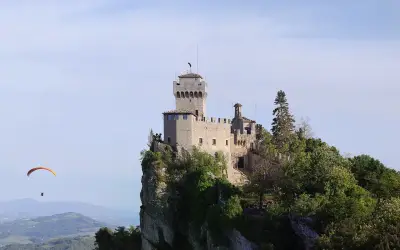
In the Cesta, the Second Tower on the top of Monte Titano, the weapons museum of the State Museums of San Marino, opened in 1956: armour, blades, crossbows and firearms from the Middle Ages to the 19th century.
When and how to see it
Open every day, with a ticket (also combined with the other towers and the State Museums).
Source and information In the museums In the castles Discover San Marino
Armeria Albicini e Museo Storico Dante Foschi
Forlì
In Forlì, in Palazzo del Merenda, the Albicini Armoury collects old weapons and armour; in the Casa del Mutilato in via Maroncelli the Dante Foschi Historical Museum keeps uniforms, weapons, memorabilia and documents from the Risorgimento to the Second World War.
When and how to see it
Opening times vary: check on Turismo Forlivese before going.


All the other museums, with hours and tickets, are on the page Museums and exhibitions
The art of reuse
When the war ended, the people of Romagna were left with destroyed homes and fields full of abandoned military material. So war reuse was born: helmets became buckets, funnels, chestnut pans and colanders; shell cases became jewellery boxes and vases; hand grenades ashtrays; telephone cable chairs, slippers and covers for demijohns; parachute silk wedding dresses and the aluminium of crashed planes pots and ladles. It happened after 1918 too, but in Romagna, where the front had stood still for months, it was a huge phenomenon.
Bruno Zama, a collector born in Faenza who lives in Lugo, has gathered since 2010 about 3,500 of these objects, one of the largest collections in the world: it all began with a funnel made from a German helmet and shell case found at a flea market. There are unique pieces such as a mandolin whose body is a French helmet from 1915. With J. Pascal Marcacci he wrote "I riciclanti della Linea Gotica" (2012) and "Recuperanti e riciclanti delle due guerre mondiali" (2014).
Where it has been shown and where to see it
- Today in the Alidosi rooms of the War and Gothic Line Museum of Castel del Rio, the exhibition "From the front to the hearth" (Sundays and holidays 2-6 pm), and in the reuse section of the Senio Battle Museum in Alfonsine.
- 2023 "From war to peace", Senio Battle Museum, Alfonsine, from 10 April.
- 2020 "German enamels WW2", Alfonsine: planned for March and postponed.
- 2017 - 2021 "From the front to the hearth", Castel del Rio, from 25 April 2017, then extended.
- 2013 - 2014 one year at the Francesco Baracca Museum in Lugo.
No new Bruno Zama exhibition has been announced so far: as soon as a date comes out you will find it in the calendar of Events
War cemeteries and memorials
Soldiers from half the world lie in Romagna: British, Canadians, New Zealanders, Indians, Gurkhas, Greeks, Italians and Germans. Close by, in the province of Pesaro, are also the cemeteries of Gradara (1,192 dead) and Montecchio (582).

Coriano Ridge War Cemetery
Coriano
On the ridge where fighting raged for days in September 1944 lie 1,940 Commonwealth soldiers, about fifty of them never identified. The land, says the stone at the entrance, was given by the Italian people.
When and how to see it
Open every day, free entry; the register of names is at the entrance.
Rimini Gurkha War Cemetery
Rimini
Along the dual carriageway between Rimini and San Marino, 618 graves of Gurkha and Indian soldiers who fell in the battle of Rimini.
When and how to see it
Open every day, free entry.
Cimitero militare greco
Riccione
Cut into the cliff next to the ancient Via Flaminia, it holds 114 soldiers of the Greek Third Mountain Brigade, which fought for Rimini in September 1944. A statue of Athena and a large metal cross stand above it.
When and how to see it
Visible from the road; free entry.

Cesena War Cemetery
Cesena
About 775 Commonwealth dead of the Second World War, who fell in the fighting of autumn 1944 between the Savio and the Ronco.
When and how to see it
Open every day, free entry.

Forlì Indian Army War Cemetery
Forlì
The cemetery of the soldiers of the Indian Army: just under 500 burials and a memorial with the names of more than 700 Hindu and Sikh soldiers who, according to their religion, were cremated.
When and how to see it
Open every day, free entry.
Cimitero inglese di Meldola
Meldola
145 British soldiers who fell between October and November 1944 freeing the Bidente valley; in the centre a cross on an octagonal base.
When and how to see it
Open every day, free entry.
Faenza War Cemetery
Faenza
1,152 Commonwealth dead, 13 of them unnamed: mostly New Zealanders, British and Indians of the December 1944 fighting for Faenza and of the winter on the Senio.
When and how to see it
Open every day, free entry.
Santerno Valley War Cemetery
Valle del Santerno, oltre Castel del Rio
At the head of the Santerno valley, 287 Commonwealth soldiers who fell on the mountains between Imola and Firenzuola, around Monte Battaglia.
When and how to see it
Open every day, free entry.

Ravenna War Cemetery
Piangipane, Ravenna
Created in 1945 on the road to Ferrara: 956 dead, including 438 Canadians, 250 British, 120 Indians, 96 New Zealanders and 33 of the Jewish Brigade. Since 1974 it also holds 33 dead of the First World War brought from Gradisca.
When and how to see it
Open every day, free entry.
Cimitero del Gruppo di Combattimento Cremona
Camerlona, Ravenna
Along the Adriatic main road, 74 soldiers of the Cremona Combat Group, the Italian army unit that from December 1944 fought alongside the Allies; its general, Clemente Primieri, is buried here too.
When and how to see it
Free entry.

Villanova Canadian War Cemetery
Villanova di Bagnacavallo
On the night of 10 to 11 December 1944 the Canadians crossed the Lamone here. 206 Canadians and 6 British lie here; the monument beside it is a piece of Bailey bridge, the iron bridges the Allies built over the rivers.
When and how to see it
Open every day, free entry.
Sacrario dei caduti ravennati
Ravenna, Cimitero Monumentale
In the Monumental Cemetery of Ravenna six semicircular steles bear the names of 621 soldiers from Ravenna who fell in the two world wars: five for the First, one for the Second. In almost every town of Romagna a plaque or a monument in the square remembers the dead of the Great War.
When and how to see it
During the cemetery's opening hours, free entry.

Cimitero militare germanico della Futa
Firenzuola
At the Futa Pass, on the Gothic Line, the largest German war cemetery in Italy: more than 30,000 soldiers, along a two-kilometre stone wall that spirals up to the top. It was opened in 1969.
When and how to see it
Open every day, free entry.


The places of the massacres
In 1944 the war struck civilians above all. These are places of silence: visit them with respect.
Fragheto
Casteldelci
On 7 April 1944, Good Friday, in the small village of the upper Marecchia valley 30 of the 75 inhabitants were killed, mostly women, old people and children; with the captured partisans the victims were about 45. The post-war trial stopped: the files lay for decades in the so-called "cabinet of shame".
When and how to see it
The village and the memorial stone can be visited freely; every April there is a commemoration.
Tavolicci e Campo del Fabbro
Verghereto
On the night of 22 July 1944, 64 people were killed at Tavolicci, including 19 children under ten; the men arrested were taken to Campo del Fabbro, about two kilometres away, and killed there. The house of the massacre holds the permanent photo exhibition "Massacres and killings in the province of Forlì", rebuilt rooms and copper works by Lucio Cangini.
When and how to see it
The place is always accessible; for the house museum ask the town of Verghereto.
Passo del Carnaio
Bagno di Romagna
On 25 July 1944, after three German soldiers were killed, about 70 people were rounded up around San Piero in Bagno; 26 men were shot under an ancient oak at the pass and a boy was hanged from a telegraph pole. Since 2020 the chapel of the San Piero in Bagno cemetery has been a memorial with the names and ages of the victims in gold leaf.
When and how to see it
The pass is on the road between San Piero in Bagno and Santa Sofia, always accessible.
Cippo La Fornace e Fornace Bisulli
Meldola
In August 1944 about 180 men who had been rounded up were locked in the Bisulli brickworks, interrogated and tortured. On 21 August 18 of them were shot after being forced to dig their own grave: the La Fornace memorial, at the entrance to Meldola, bears their names.
When and how to see it
The memorial stone is by the road, always visible.
Parco della Resistenza di Sorbano
Sarsina
On 28 September 1944, 16 hostages taken in Sarsina were shot here; six survived the execution. Since the 1970s the place has been the Park of the Resistance, with paths, a votive temple and a sculpture by Ilario Fioravanti.
When and how to see it
The park is always open, free entry.
Ca' Cornio e la banda Corbari
Modigliana e Forlì
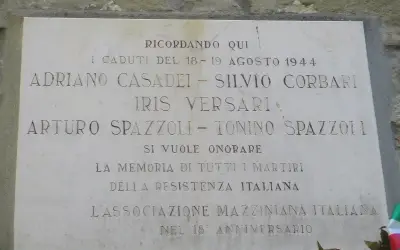
Ca' Cornio was the last hiding place of Silvio Corbari and his comrades: on 18 August 1944 they were surprised here. Iris Versari took her own life; Corbari, Arturo Spazzoli and Adriano Casadei were captured; Corbari and Casadei were hanged from the lamp posts of piazza Saffi in Forlì and the bodies left on display for days with those of Versari and Spazzoli. The farmhouse has been restored and is run by the Agesci scouts.
When and how to see it
You get there on foot on the marked CAI trails 573 and 573B, with panels that tell the story.
Eccidio dell'aeroporto di Forlì
Forlì
In September 1944, in the area of Forlì airport, 42 prisoners of the city jail were killed: 18 Jewish men and women, 17 of them foreigners, and 24 anti-fascists, partisans or their relatives. The killings took place on several days (5-6, 17 and 25 September) and were partly concealed.
When and how to see it
Every September Forlì remembers the victims with a ceremony.

Piazza Tre Martiri
Rimini
On 16 August 1944, in what was then piazza Giulio Cesare, three young partisans were hanged, Mario Capelli, Luigi Nicolò and Adelio Pagliarani, arrested two days earlier and tortured for the names of their comrades; the bodies were left on display for three days. On 9 October 1944 the square took their name.
When and how to see it
In the heart of the town, always accessible; the commemoration is every year on 16 August.
Ponte dei Martiri (Ponte degli Allocchi)
Ravenna
On 25 August 1944, in reprisal, 12 anti-fascists were killed at the Ponte degli Allocchi: ten shot and two hanged, Umberto Ricci and Natalina Vacchi. About 400 people of Ravenna were arrested. Today the place is called Ponte dei Martiri: the monument by Giò Pomodoro from 1980 stands at the crossing of via Nullo Baldini, via Piave and via Mura di Porta Gaza.
When and how to see it
Always accessible; the ceremony is every year on 25 August.
Sacrario di Madonna dell'Albero
Ravenna
On 27 November 1944, south of Ravenna, after a German soldier was killed, 56 people were machine-gunned near a hut, including 16 children and 17 women. The memorial is built of 5,000 bricks.
When and how to see it
Always accessible; the commemoration is every year at the end of November.
Monte Sole
Marzabotto, Bologna
Outside Romagna but an hour's drive away: between 29 September and 5 October 1944, on the slopes of Monte Sole around Marzabotto, about 770 civilians were killed. It is the largest massacre committed in Italy in the Second World War; today it is a historical park with the ruins of the hamlets and trails.
When and how to see it
The park is always open; guided tours on the site of the Monte Sole Peace School.


Imprisonment and internment
Improvised prisons, the largest prisoner camp in Italy on the Riviera and, close by, Fossoli.
Enklave Rimini, i campi dei prigionieri tedeschi
Da Riccione a Cervia, Miramare
After the war, from May 1945 to the beginning of summer 1947, the British held the German prisoners of war and those who had fought for the Third Reich on the coast between Riccione and Cervia: a network of camps designed for about 150,000 people, the largest in Italy. Its centre was Miramare airport, which from autumn 1945 became "the largest German city outside Germany". Today nothing visible remains.
When and how to see it
It is told in the books by Patrizia Dogliani and Alessandro Agnoletti and in the "Enklave Rimini" podcast of the Gambalunga Library.
Il rastrellamento della Fornace Bisulli
Meldola
In August 1944 the Meldola brickworks became a prison: about 180 men rounded up in the valleys were locked in here, interrogated and tortured before the executions of 21 August.
When and how to see it
The memory is kept by the La Fornace memorial stone (see Massacres).
Campo di Fossoli
Carpi, Modena
Outside Romagna, in Carpi: built in 1942 as a prisoner of war camp, from 1943-44 it was used by the Italian Social Republic and the SS as a police and transit camp towards the Nazi camps. Primo Levi left from here in February 1944. Today you can visit the huts and the Museum Monument to the Deportee.
When and how to see it
Openings and guided tours on the Fossoli Foundation's site.
San Marino, il rifugio di 100.000 sfollati
San Marino
In the summer and autumn of 1944 neutral San Marino opened its borders: with about 15,000 inhabitants it took in, according to the official figures of the Republic, about 100,000 displaced people from Romagna and the Marche, who lived everywhere, including in the railway tunnels.
When and how to see it
The full story is in our curiosities.
No source we read names prison camps you can visit in Romagna from earlier wars: if you know of one, tell us at the bottom of the page.
Trails, ridges and strongholds
Walking where the front ran, and the fortresses nobody could take.
Sentiero della Memoria di Gemmano
Gemmano
A CAI-marked loop starting from the centre of Gemmano and touching the places of the battle of September 1944: about 8 kilometres and 280 metres of climbing, in about three hours.
When and how to see it
Always open; mixed surface, hiking shoes. Water in piazza Roma.
Sentiero della Pace, Casola Valsenio - Monte Battaglia
Casola Valsenio
The trail that climbs from Casola Valsenio to Monte Battaglia, on the ridge of the battle of autumn 1944, proposed by the Linea Gotica Association; the Way of the Gothic Line makes it one of its variants.
When and how to see it
A day hike, best in spring and autumn; bring water, there is little shade on the ridge.
Source and information In the castles Nature and trails Discover Casola Valsenio
Sentiero dei Partigiani di Ca' di Malanca
Brisighella
The Partisans' Trail leads to the Ca' di Malanca museum along the CAI trails 579 and 505, through woods and ridges where the 36th Garibaldi brigade moved in 1944.
When and how to see it
Marked, always open; mountain shoes.
Parco della Pace e della Resistenza di Pieve di Rivoschio
Sarsina
Pieve di Rivoschio was the base of the 8th Garibaldi Romagna brigade. The Park of Peace and Resistance remembers with a plaque the victims of the round-up of August 1944.
When and how to see it
Always accessible.
Il Cammino della Linea Gotica
Da Cinquale (Toscana) a Montecchio (Pesaro)
A walk in stages along the whole Gothic Line, from Cinquale di Montignoso in Tuscany to Montecchio di Pesaro in the Marche, crossing the Apennines of Romagna. It runs mostly on CAI trails and minor roads, but some stretches have no signs.
When and how to see it
Bring a detailed map or the GPS track from the site.

Fortezza di San Leo, la rocca imprendibile
San Leo
On its sheer rock the fortress was considered impregnable for centuries: that is why it became the prison of the Papal State, where the count of Cagliostro died in 1795. It is the impregnable stronghold of Romagna above all others.
When and how to see it
Open all year with a ticket; the road up to the village is steep.
Source and information In the castles In the curiosities Discover San Leo

For the other trails and parks see also Nature and trails · Castles
Fallen aircraft and unexploded bombs
Where the military aircraft that crashed have been found, and who looks for them.
Il Messerschmitt di San Bernardino
San Bernardino, Lugo
The first find of the Romagna Air Finders, on 13 August 1998: the Messerschmitt Bf 109 G-6 of Lieutenant Hans Joachim Fischer of JG 53 "Pik-As", shot down in 1944 in the fields of San Bernardino di Lugo. The engine block lay about 2.5 metres underground; the pilot's remains were recovered with the plane. Reassembled, it is on display in the association's museum.
When and how to see it
You can see it at the Romagna Air Finders museum in Maiano di Fusignano.
I due F-104 di Fontanelice
Fontanelice e Tossignano
Not war, but military history: on 7 November 1991 two F-104 Starfighter jets that had taken off from Rimini Miramare collided during a night training flight and fell in the woods between Fontanelice and Tossignano. The pilots, Captain Andrea Scali and Second Lieutenant Fabrizio Majerna, ejected safely. The Romagna Air Finders recovered the fragments, with the serial numbers of both planes.
When and how to see it
The finds are on display at the Maiano Monti museum.
Il Thunderbolt brasiliano di Livergnano
Livergnano, Pianoro (Bologna)
In the Bologna Apennines, at Livergnano, the P-47 Thunderbolt of Second Lieutenant John Richardson Cordeiro e Silva of the 1st Brazilian Fighter Group crashed in 1944: Brazil fought in Italy with the Allies. The remains are in the Romagna Air Finders museum.
When and how to see it
At the Romagna Air Finders museum.
The Romagna Air Finders
They are a group of volunteers from the Bassa Romagna led by their president Leo Venieri. Since their first dig on 13 August 1998 they have recovered 44 fallen aircraft and the remains of 14 pilots, British, German, Italian and American, who were given a funeral and burial with military honours.
The work starts from the accounts of people who saw the plane fall, rarer every year, checked against the documents of the time: flight plans, logs and mission reports. Then the metal detector, the permits and the dig, sometimes more than seven metres deep, and finally the restoration of the pieces for the museum.
Warning: unexploded bombs
Eighty years later, the soil of Romagna still gives back bombs, grenades and shells: in ploughed fields, on building sites, on beaches and along river banks, above all after high water and floods. After the 2023 flood the Prefectures of Forlì-Cesena and Ravenna warned that the water could have moved or uncovered ordnance; in Faenza a British 500-pound bomb found in 2023 was defused in 2024 with the evacuation of the area, in Cesenatico in 2026 a device was blown up on the beach.
The bomb disposal engineers of the Genio Ferrovieri, who cover the provinces of Bologna, Forlì-Cesena and Rimini, were called out about 300 times in 2025 and destroyed 900 devices. If you find a metal object that looks like a shell: do not touch it, do not move it, do not go close to photograph it, move away, mark the spot and call 112.
At sea: wrecks and attacks
What the war left on the seabed of the Romagna Adriatic.
Il bombardiere B-24 davanti a Rimini
Al largo di Rimini
Off Rimini, between 62 and 66 metres deep, lie the remains of an American B-24 heavy bomber, armed with six .50 calibre machine guns, today covered with marine life.
When and how to see it
Only for very experienced divers with a Trimix licence, with the Rimini diving centres.
Rimini bombardata dal mare, 1915
Rimini, porto e ferrovia
At dawn on 24 May 1915, the day after Italy entered the war, the Austro-Hungarian fleet shelled the Adriatic coast: the cruiser Sankt Georg with two torpedo boats hit Rimini, damaging the harbour and a goods train. It was the first attack of the Great War on Romagna.
When and how to see it
A story to remember while walking along the Rimini harbour canal.
MAS, Museo Nazionale delle Attività Subacquee
Marina di Ravenna
The National Museum of Underwater Activities tells the story of divers and diving, military diving included, with diving suits, equipment and instruments. The most famous wreck of our seabed, the Paguro platform sunk in 1965 off Ravenna, is not military but is today an oasis of marine life.
When and how to see it
Hours on the museum's site.
In the sea of Romagna there is today no large, identified warship wreck open to divers: the research of the diving clubs is still going on. Another sea story: The Isola delle Rose
Linked to this page
History of Romagna
The timeline from the Neolithic to today: war and Liberation in context.
Curiosities and legends
The Rubicon, the Rio Sanguinario, San Marino refuge for 100,000 people, Baracca and the prancing horse.
Famous people of Romagna
Francesco Baracca, Caterina Sforza and the other figures of history.
Museums and exhibitions
All the museums of Romagna, with the exhibitions on now.
Castles and fortresses
The fortresses built for war: Monte Battaglia, San Leo, Ravaldino, the towers of San Marino.
The Futa cemetery
The full card in the monuments, with hours and what to see.
Nature and trails
Parks, pine woods and trails where the front ran: the Vena del Gesso, Onferno, the Delta.
Events calendar
The bunker tours and special openings, with up-to-date dates.
Facts read on 20 October 2026 on the official sources given on each card. Hours and openings change: always check before you go.
A day among the places of remembrance
Cemeteries, museums and ridges far apart: with Romagna Transfer we take you from one place to the next and bring you back to your hotel.
Is something missing, or would you like to add some information? Tell us.
Have you found a mistake or something not quite right? Let us know.