
War cemeteries in Romagna
British, Canadians, New Zealanders, Indians, Gurkhas, Greeks, Poles, Italians and Germans: in the winter of 1944-45 the front stopped in Romagna for eight months, and the dead of half the world still rest here, among the vineyards and along the roads. How, when and why these cemeteries were made, why they still exist, where they are and how the towns remember those who died in the two wars.
How, when and why
The story of the war cemeteries in six questions.
Why here
After the liberation of Rome in June 1944 the Germans withdrew to the Gothic Line, along the Apennines. The Allies broke through it in the autumn and reached Ravenna, but with the winter the front stopped on the Senio until April 1945.
For eight months Romagna was a battlefield: the cemeteries were made in those months, close to the fighting, to bury the dead.
How and when they were made
Many soldiers were first buried in temporary graves near where they fell, then brought together in cemeteries chosen by the army along the roads of the front. The Faenza cemetery was begun in the winter of 1944, the Ravenna one in 1945.
The Polish cemetery of Bologna was built by Polish sappers between 1 July and 15 December 1946. The great German cemetery of the Futa came later: opened in 1969, it gathers German soldiers who had first been buried in over 2,000 Italian towns.
Why they did not go home
In 1915 the British government banned bringing the bodies of soldiers home: for hygiene, and because only wealthy families could have afforded it.
On 21 May 1917 the Imperial War Graves Commission was founded by Royal Charter, at the urging of Fabian Ware, a former journalist too old to enlist. The principle: every one of the dead remembered by name, with the same headstone, with no distinction of rank, race or creed. Since 1960 it has been called the Commonwealth War Graves Commission (CWGC).
Why they still exist
They are protected by treaties between states. With the Rome agreement of 27 August 1953 (Law no. 262 of 2 February 1955) Italy gave the Commonwealth countries the free use of the land for as long as it remains a war cemetery. Similar agreements cover Germany (Bonn, 22 December 1955), France, the United States and Poland, and the Geneva Conventions of 1949 require the graves of the dead to be respected.
That is why, unlike ordinary graves, which can be cleared after some years, these remain for ever. And families still come from far away to find a name.
Who looks after them
The Commonwealth cemeteries are looked after by the CWGC's gardeners, funded by the six member governments: the United Kingdom, Canada, Australia, New Zealand, India and South Africa, each in proportion to its dead.
The German cemetery of the Futa is looked after by the Volksbund, the German war graves association, on behalf of the German government, also with camps of young volunteers from all over Europe. The Polish cemetery of Bologna is entrusted to the General Commissariat for the Honours to the Fallen of the Italian Ministry of Defence.
How they are built
The headstones of the Commonwealth cemeteries are all the same: the badge of the unit, the name, the rank, the age, the date of death, a religious symbol and, if the family wished, a short line of their own choosing. The graves without a name read "Known unto God", words chosen by Rudyard Kipling.
In the middle stands the Cross of Sacrifice by Reginald Blomfield; in the largest cemeteries also the Stone of Remembrance by Edwin Lutyens, inscribed "Their name liveth for evermore". The Hindu and Sikh soldiers were cremated, as their religion requires: in Forlì a memorial bears 771 names.
Where they are
The map follows the front: from the coast of Rimini, broken through in September 1944, to the hills of Cesena and Forlì in the autumn, to the Senio of the winter. Tap a point to open its card.
- Rimini and the Valconca
- Cesena and Forlì
- Ravenna and the Bassa Romagna
- Faenza, Imola and the valleys
- Just outside Romagna
No cemetery found: try another word.
Rimini and the Valconca
Where the Gothic Line was broken on the coast, in September 1944: Coriano, Rimini, Riccione.

Coriano Ridge War Cemetery
Coriano
1,940 graves
On the ridge where fighting raged for days in September 1944 lie 1,940 Commonwealth soldiers, about fifty of them never identified. The land, says the stone at the entrance, was given by the Italian people.
When and how to see it
Open every day, free entry; the register of names is at the entrance.
Rimini Gurkha War Cemetery
Rimini
618 graves
Along the dual carriageway between Rimini and San Marino, 618 graves of Gurkha and Indian soldiers who fell in the battle of Rimini.
When and how to see it
Open every day, free entry.
Cimitero militare greco
Riccione
114 graves
Cut into the cliff next to the ancient Via Flaminia, it holds 114 soldiers of the Greek Third Mountain Brigade, which fought for Rimini in September 1944. A statue of Athena and a large metal cross stand above it.
When and how to see it
Visible from the road; free entry.
Source and information War and remembrance Discover Riccione

Cesena and Forlì
The fighting of autumn 1944 on the Savio, Ronco and Montone rivers, up to the liberation of Forlì on 9 November.

Cesena War Cemetery
Cesena
775 graves
About 775 Commonwealth dead of the Second World War, who fell in the fighting of autumn 1944 between the Savio and the Ronco.
When and how to see it
Open every day, free entry.
Forlì War Cemetery
Forlì, San Varano
738 graves
One of the two Commonwealth war cemeteries of Forlì: 738 graves of soldiers from Canada, Cyprus, India, Lesotho, Mauritius, New Zealand, Palestine, the Seychelles, South Africa and the United Kingdom, who fell in the fighting for the town and on the rivers around it.
When and how to see it
Free entry. It lies south of the town, at San Varano; the other one, the cemetery of the Indian soldiers, is on Via Ravegnana, opposite the Certosa.

Forlì Indian Army War Cemetery
Forlì
496 graves · 771 names of cremated soldiers
The cemetery of the soldiers of the Indian Army: just under 500 burials and a memorial with the names of more than 700 Hindu and Sikh soldiers who, according to their religion, were cremated.
When and how to see it
Open every day, free entry.
Cimitero inglese di Meldola
Meldola
145 graves
145 British soldiers who fell between October and November 1944 freeing the Bidente valley; in the centre a cross on an octagonal base.
When and how to see it
Open every day, free entry.


Ravenna and the Bassa Romagna
Canadians, British and the Italians of the Cremona Group: the battles of December 1944 on the Lamone and of the winter along the Senio.

Ravenna War Cemetery
Piangipane, Ravenna
956 graves
Created in 1945 on the road to Ferrara: 956 dead, including 438 Canadians, 250 British, 120 Indians, 96 New Zealanders and 33 of the Jewish Brigade. Since 1974 it also holds 33 dead of the First World War brought from Gradisca.
When and how to see it
Open every day, free entry.

Villanova Canadian War Cemetery
Villanova di Bagnacavallo
212 graves
On the night of 10 to 11 December 1944 the Canadians crossed the Lamone here. 206 Canadians and 6 British lie here; the monument beside it is a piece of Bailey bridge, the iron bridges the Allies built over the rivers.
When and how to see it
Open every day, free entry.
Source and information War and remembrance Discover Bagnacavallo
Cimitero del Gruppo di Combattimento Cremona
Camerlona, Ravenna
74 graves
Along the Adriatic main road, 74 soldiers of the Cremona Combat Group, the Italian army unit that from December 1944 fought alongside the Allies; its general, Clemente Primieri, is buried here too.
When and how to see it
Free entry.
Sacrario dei caduti ravennati
Ravenna, Cimitero Monumentale
621 names
In the Monumental Cemetery of Ravenna six semicircular steles bear the names of 621 soldiers from Ravenna who fell in the two world wars: five for the First, one for the Second. In almost every town of Romagna a plaque or a monument in the square remembers the dead of the Great War.
When and how to see it
During the cemetery's opening hours, free entry.


Faenza, Imola and the valleys
The front of the winter of 1944-45 between Faenza and the Senio, and the mountains between Imola and Firenzuola.
Faenza War Cemetery
Faenza
1,152 graves
1,152 Commonwealth dead, 13 of them unnamed: mostly New Zealanders, British and Indians of the December 1944 fighting for Faenza and of the winter on the Senio.
When and how to see it
Open every day, free entry.
Santerno Valley War Cemetery
Valle del Santerno, oltre Castel del Rio
287 graves
At the head of the Santerno valley, 287 Commonwealth soldiers who fell on the mountains between Imola and Firenzuola, around Monte Battaglia.
When and how to see it
Open every day, free entry.
Source and information War and remembrance Discover Castel del Rio
Just outside Romagna
Less than an hour away: the Commonwealth cemeteries in the province of Pesaro, the Polish cemetery of Bologna and the great German cemetery of the Futa Pass.
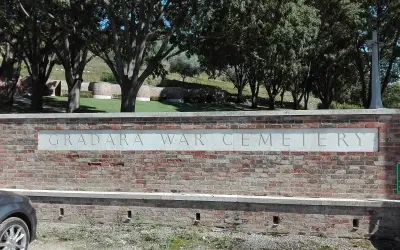
Gradara War Cemetery
Gradara (Pesaro e Urbino)
1,192 graves
At the foot of the hill of Gradara, just across the border with the Marche, 1,192 Commonwealth dead, most of them killed breaking through the Gothic Line on the Adriatic coast from August 1944.
When and how to see it
Free entry. It goes well with a visit to the castle of Gradara.
Montecchio War Cemetery
Tra Montecchio e Osteria Nuova (Pesaro e Urbino)
582 graves
In the Foglia valley, where the Gothic Line ran: 582 Commonwealth dead of the fighting of summer 1944.
When and how to see it
Free entry.
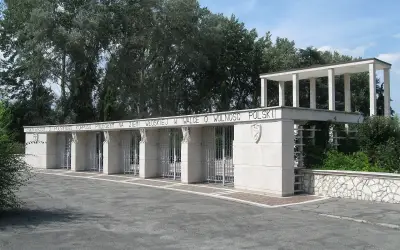
Cimitero militare polacco di Bologna
Bologna, verso San Lazzaro di Savena
1,432 graves
The largest of the four Polish cemeteries in Italy: 1,432 soldiers of General Anders' 2nd Corps, killed on the Gothic Line, in the Apennines and in the battle of Bologna, 18 of them without a name. The Poles freed Predappio and Imola and were the first to enter Bologna on 21 April 1945. Their sappers built it in 1946, with Italian stonemasons.
When and how to see it
On the eastern edge of Bologna, on the border with San Lazzaro di Savena. Consecrated on 12 October 1946.

Cimitero militare germanico della Futa
Firenzuola
over 30,000 graves
At the Futa Pass, on the Gothic Line, the largest German war cemetery in Italy: more than 30,000 soldiers, along a two-kilometre stone wall that spirals up to the top. It was opened in 1969.
When and how to see it
Open every day, free entry.
Source and information War and remembrance Discover Firenzuola


And the First World War?
The Great War was fought far from Romagna, in the Alps and on the Karst: many of the fallen from Romagna rest in the military memorials of the north-east, such as Redipuglia. Here the war came from the sea, with the Austrian ships that shelled Rimini and the coast in 1915.
At home their names remain: almost every town has its war memorial in the square. From 1922, at the proposal of under-secretary Dario Lupi, many towns planted a Park or Avenue of Remembrance, one tree for each of the dead with a small plate bearing his name: several still exist.
In the Monumental Cemetery of Ravenna the memorial bears 621 names of soldiers from Ravenna of the two wars, and since 1974 the Ravenna War Cemetery has also held 33 Commonwealth dead of the First World War, brought from Gradisca. The best-known man from Romagna who fell in the Great War is the airman Francesco Baracca, from Lugo.
The commemorations in the towns
Month by month, the ceremonies with which Romagna remembers those who died in the two wars: soldiers, partisans and civilians. They are public: anyone can attend.
-
7 April
The massacre of Fragheto
Fragheto, Casteldelci Second World War
On 7 April 1944 German soldiers killed 30 people in this hamlet of Casteldelci. Every year, on the nearest Saturday or Sunday, there is a mass in Fragheto and a wreath at the monument to the victims: in 2026 on 11 April, the 82nd anniversary.
-
10 April
The liberation of Alfonsine
Alfonsine e Camerlona Second World War
On the morning of 10 April 1945 the Italian soldiers of the Cremona Combat Group entered the town. The ceremony starts at the memorial of Camerlona, where the dead of the Cremona lie, then the procession takes the wreaths to the memorial of the partisans; often an exhibition opens at the Museum of the Battle of the Senio.
Cimitero del Gruppo di Combattimento Cremona Discover Alfonsine Source
-
14 April
The liberation of Imola
Imola Second World War
On 14 April 1945 Imola was freed by the troops of the Polish 2nd Corps and by the partisans. In 2025, for the 80th anniversary, the Polish Consulate laid a wreath at the monument to General Anders, in the garden named after him. The Polish dead lie in the Polish military cemetery of Bologna.
-
25 April
Liberation Day
In every town Second World War
A national holiday. In every town, processions and wreaths at the plaques, at the war memorials and at the memorials of the partisans; in Bagnacavallo the procession goes as far as the Canadian cemetery of Villanova.
-
19 June
Francesco Baracca in Lugo
Lugo First World War
The flying ace of the First World War, born in Lugo, died in flight on 19 June 1918. The town remembers him every year at his monument: in 2026, the centenary of the Baracca Museum, there were wreaths with the civil and military authorities and a flyover of historic aircraft.
-
22 July
The massacre of Tavolicci
Tavolicci, Verghereto Second World War
On 22 July 1944, 64 people were killed in Tavolicci, 19 of them children under ten. Every year there are wreaths at the House-Museum of the massacre, a mass and the reading of the names of the victims; in the same days Castelpriore, struck on 20 July, is remembered too.
-
14-16 August
The Three Martyrs of Rimini
Rimini Second World War
On 16 August 1944 Mario Capelli, Luigi Nicolò and Adelio Pagliarani were hanged in the square that now bears their name. Rimini remembers them with three days of events; the official ceremony is on 16 August, with the procession and the town band.
-
25 August
The Bridge of the Martyrs
Ravenna Second World War
On 25 August 1944, twelve partisans and anti-fascists were killed in reprisal at the Ponte degli Allocchi: ten shot, two hanged, Umberto Ricci and Natalina Vacchi. The town remembers them every year on the bridge, now the Bridge of the Martyrs, with wreaths and often a performance.
-
September
The battle of Gemmano
Gemmano Second World War
From 4 to 15 September 1944 the fighting was so hard that some historians call Gemmano "the Cassino of the Adriatic". The village remembers it in September with photo exhibitions, eyewitness accounts and period military vehicles (in 2025 on 27 September).
-
21 September
The liberation of Rimini
Rimini e Riccione Second World War
On the morning of 21 September 1944 the Greek soldiers of the Third Mountain Brigade were the first to enter the city; the brigade still bears the name "Rimini". In 2026 the mayor laid a wreath at the Commonwealth war cemetery on the dual carriageway to San Marino, with a representative of the Indian embassy, then at Monte Cieco. Over the years Greek delegations have honoured their dead at the Greek cemetery of Riccione.
-
Late September
Monte Sole, Marzabotto
Marzabotto (Bologna) Second World War
Between 29 September and 5 October 1944, on the slopes of Monte Sole, the SS killed hundreds of civilians. The ceremony is held every year on a Sunday between late September and early October, with wreaths at the memorial of Marzabotto; in 2024, for the 80th anniversary, the presidents of Italy and Germany came together. It is in the province of Bologna, an hour from Imola.
-
20 October
The liberation of Cesena
Cesena Second World War
Cesena was freed on 20 October 1944. On the anniversary the town lays a wreath at the Cesena War Cemetery, where 775 Commonwealth soldiers rest: 369 British, 307 Canadians and 93 New Zealanders, plus South Africans and Indians.
-
22 October
The liberation of Cervia
Cervia Second World War
The liberation was announced in Piazza Garibaldi on 22 October 1944. Every year, in the days around it, there is a historical re-enactment, the band concert and wreaths at more than thirty memorial stones across the area.
-
4 November
Day of National Unity and the Armed Forces
In every town First World War
It marks the end of the First World War for Italy, with the armistice of Villa Giusti in 1918. In every town there are wreaths at the war memorial, where the names of the local boys who died at the front are carved.
-
9 November
The liberation of Forlì
Forlì Second World War
On 9 November 1944 British troops entered the city, helped by the Polish advance in the Apennines. The ceremony is held in Piazza Saffi, with wreaths at the lamp posts of the square and at the Memorial to the Fallen for Freedom, in the cloister of San Mercuriale; around it, a week of talks and exhibitions.
-
11 November
Remembrance Day
Commonwealth cemeteries All wars
On the day of the 1918 armistice the Commonwealth countries remember the dead of all wars; in the United Kingdom the ceremony is on the second Sunday of November, Remembrance Sunday. Wreaths of red poppies are laid in the war cemeteries: Canadian soldiers have also come to the Canadian cemetery of Villanova.
-
27 November
The massacre of Madonna dell'Albero
Madonna dell'Albero, Ravenna Second World War
On 27 November 1944, just outside Ravenna, 56 civilians were killed. Every year a procession goes from the school to the church, where a plaque remembers the parish priest Don Domenico Turci, and then to the Memorial of the 56 Martyrs for the wreaths.
-
4 December
The liberation of Ravenna
Ravenna Second World War
On 4 December 1944 Canadian and British troops entered the city together with the partisans. The town lays wreaths in Piazza del Popolo. In the Ravenna War Cemetery at Piangipane 438 Canadians rest, almost half of those buried there.
-
17 December
The liberation of Faenza
Faenza Second World War
Faenza was freed in mid-December 1944 by the British Eighth Army, with New Zealanders and Indians in the front line. The town remembers it on 17 December: the church of the Fallen of San Bartolomeo, a procession in Piazza del Popolo, the plaque of the Punjab Regiment on Via Cavour and, at noon, the Faenza War Cemetery on Via Santa Lucia.
The dates are those of the anniversaries: when they fall on a weekday some ceremonies move to the Saturday or Sunday, and times and programmes are published every year on the towns' websites. Check before you go. Events
Finding a name
A grandfather, a great-uncle, a soldier you read about: the registers of the dead can be searched online, for free.
Commonwealth dead
The CWGC database: name, unit, date of death, cemetery and the position of the grave.
German dead
The Volksbund grave search, also for the soldiers buried at the Futa.
Italian dead
The Italian Ministry of Defence keeps the database of the dead and missing in war and the list of the agreements on war graves.
How to behave
- They are burial grounds: speak quietly, do not sit on the headstones, no picnics.
- You may take photos, discreetly; during a ceremony stay to one side.
- In the Commonwealth cemeteries there is often the register of names and the visitors' book at the entrance: a signature and a couple of lines are a kind gesture.
- A flower on a grave is welcome; do not leave things the wind can blow away.
Find out more
War and remembrance
The Gothic Line, the bunkers, the museums, the places of the massacres and the timeline of all the wars of Romagna.
History of Romagna
The war and the Liberation in the timeline from the Neolithic to today.
The Futa cemetery
The full card of the largest German military cemetery in Italy.
Museums and exhibitions
The museums of the war, of the Resistance and of the Gothic Line, with those of all Romagna.
Facts read on 24 October 2026 on the sources given: the CWGC, the Italian Ministry of Defence, the websites of the towns and of the associations. Openings and ceremonies change: always check before you go.
A day among the places of remembrance
The cemeteries are far apart and often outside the towns: with Romagna Transfer we take you from one to the next, also for a ceremony, and bring you back to your hotel.
Is something missing, or would you like to add some information? Tell us.
Have you found a mistake or something not quite right? Let us know.