In depth
What it is
The Presepio della Basilica di San Francesco is the nativity display that brings life each year to one of Ravenna's oldest and most beloved churches, just steps from Dante Alighieri's tomb. It is an artistic nativity scene, designed and built by students from the liceo artistico Nervi Severini in Ravenna, under the guidance of professor Henry Rossi, who also created the permanent nativity scene housed in the same basilica. It forms part of the rich tradition of nativity scenes that animate the churches of Ravenna's historic centre during the Christmas period.
What makes it special
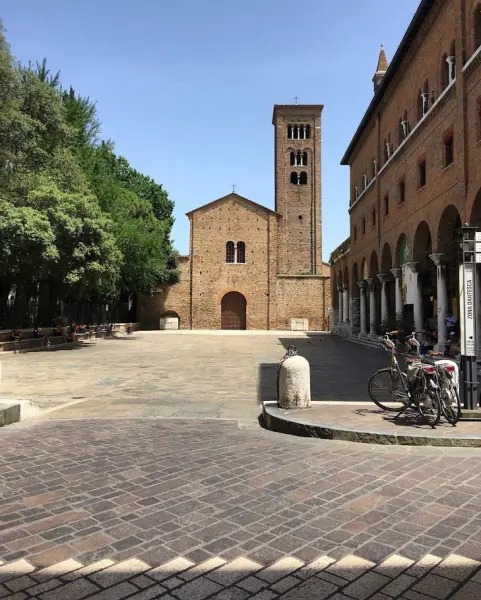
What makes it particularly special is first and foremost the place that houses it: the basilica di San Francesco, whose origins date back to the 5th century, preserves beneath its high altar a 10th-century crypt permanently flooded with water, where late antique floor mosaics can still be glimpsed among small fish swimming on the surface. The nativity scene follows the idea of Franciscan simplicity: a landscape made of little houses, mountains and valleys, crossed by a watercourse that flows with a gentle sound, as if to praise the newborn Child, just as Saint Francis himself would have wished. Beside the stable appear the ox, the donkey and a flock of sheep, a direct reference to the tradition of the nativity scene at Greccio. The work, entirely conceived and created by the students of the art school, is renewed each year.
Origins and history
Available sources do not document precisely when the collaboration between the basilica di San Francesco and the liceo artistico Nervi Severini for this nativity scene began. It is known that professor Henry Rossi has long been a key figure for Ravenna's nativity scenes: he is also responsible for the historical oriental nativity scene displayed in the basilica di Santa Maria in Porto, as well as the traditional popular nativity scene that remains permanently on display in the basilica di San Francesco. Over the years, in the same church, other nativity projects have also been presented by different groups, such as one created in the past by the Gruppo Masci di San Francesco with a mechanical nativity scene. The edition described here bears the signature of the fifth year class D of the art school, coordinated by professor Rossi.
What to see
Upon entering the basilica, the nativity scene presents itself as a small miniature landscape: little houses, hills and valleys built with simple materials, crossed by a stream that actually flows down to the Nativity grotto. Among the hills move the figurines of animals, the ox and donkey beside the manger, a flock of sheep scattered on the slopes, whilst shepherds and small rural buildings complete the scene. Before or after visiting the nativity scene it is worth pausing to observe, beneath the high altar, the submerged crypt of the basilica with its 5th-century floor mosaics visible beneath a veil of water, and to pay homage, just steps away, at Dante's tomb.
When and how to visit
The nativity scene is set up each year during the Christmas period, generally between early December and Epiphany. In the most recent documented edition it was visible from 9 December 2025 to 6 January 2026, daily from 7am to 6.30pm, during the basilica's opening hours. Admission is free. For dates and times of the current edition it is always advisable to check with the basilica di San Francesco or with the tourist offices of the Comune di Ravenna, as the nativity scene calendar is published year by year.