Christmas Nativity Scenes 2026: the nativity scenes of Romagna and Bologna, where they are and when they open Discover them →
Ask Romagna TourismAsk

Nativity scene

Animated nativity scene of the Basilica of San Rufillo

Italian name: Presepe animato della Basilica di San Rufillo

In the heart of the Basilica of San Rufillo in Forlimpopoli, a mechanical and sound nativity scene tells a different episode of Jesus's life each year, with moving figurines, lights and narration.

  • WhenUsually in December
    The dates of the next edition are not out yet. Last edition: 25 December 2025 - 1 February 2026.
  • TimesWeekdays 9-18, Saturday 9-19, holidays 8.30-19
  • WhereBasilica di San Rufillo, Forlimpopoli
    Open on the map

Official site

Dates are those announced by the organisers and may change: always check the official site of the event before you leave.

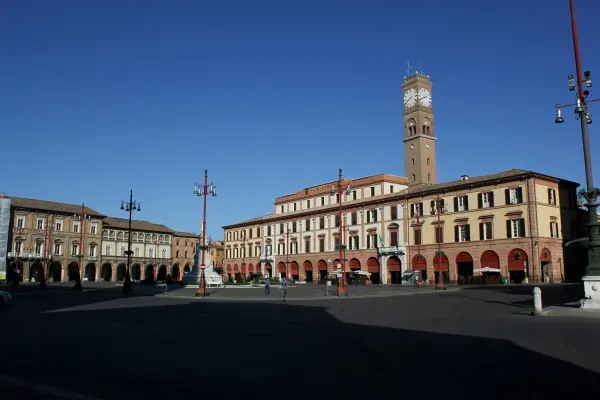
The place: Facciata esterna della Basilica di San Rufillo a Forlimpopoli, dove si allestisce il presepe
The place: Facciata esterna della Basilica di San Rufillo a Forlimpopoli, dove si allestisce il presepe · Photo: Icio747, CC BY-SA 3.0, Wikimedia Commons

Getting to Forlimpopoli

From the airport, the station or your hotel: a driver takes you to the entrance and picks you up at the end. Fixed price, book online in two minutes.

Book your transfer

Service by Romagna Transfer. Their site opens.

About this nativity scene

How it is made

Mechanical or animated nativity scene

The nativity scene stage covers about 16 square metres, with hand-painted plaster and wood scenery that opens like a curtain. The approximately 40 moving statues, 19 and 30 centimetres tall, are hand-dressed and moved by electric motors and servomotors, mostly with camshafts. Two microprocessor control units operate trapdoors, lifts, rotating platforms and doors, while the lights reproduce the passing of the day and a narrating voice changes every year. It is built by a group of friends from the parish, led by Bruno Alberto Bagagli, who creates moving statues, buildings and mechanisms.

  • About 40 hand-dressed moving statues
  • Hand-painted plaster and wood scenery
  • Two microprocessor control units
  • Lights simulating day and night

Edition

The edition number is not published: it is held every year at Christmas.

Where it is

Basilica di San Rufillo
Via Pellegrino Artusi, 17, 47034 Forlimpopoli (FC)

The nativity scene is inside the Basilica di San Rufillo, the neoclassical church of Forlimpopoli with a large portico with eight columns on the facade and a Lombard bell tower from 1521. The basilica stands just outside the ancient city walls. During the Sunday masses at 11.30 and 18.00 the nativity scene remains switched off.

Directions Open on the map

How to get there

By car
Forlimpopoli is on the Via Emilia (SS9), between Forlì and Cesena. From the A14 exit at the Forlì or Cesena toll booth and follow the Via Emilia to Forlimpopoli, about 10 or 15 kilometres. In town follow the signs for the centre and the basilica.
By train
Forlimpopoli has its own station on the Bologna-Rimini railway line, a few minutes' walk from the centre. Alternatively you can arrive at the stations in Forlì or Cesena and continue to Forlimpopoli.

No car, or late in the evening after your visit: a driver takes you right to the nativity scene and back to your hotel.

Book your transfer

Admission

Admission by donation

Free admission, with voluntary donation for missionary works.

Information gathered from public sources (parishes, local associations, town halls, local press) about the last edition: check dates and hours on the official site before you set off.

In depth

What it is

The Presepe animato della Basilica di San Rufillo is a mechanical and sound nativity scene set up every year inside the basilica minore di San Rufillo, in the centre of Forlimpopoli, in the province of Forlì-Cesena. It is not a static Nativity, but a true miniature theatrical narrative: animated scenes, lights and audio commentary accompany the visitor on a journey that each year chooses a different episode from the life of Jesus or from the Holy Scriptures, combining spectacle with an intent of catechesis.

What makes it special

What makes this nativity scene unique is above all the technique with which it is built: the scenery is made entirely of plaster and wood, hand-painted, on an opening stage front that occupies about 16 square metres. The moving figures are about forty, in two sizes (19 and 30 centimetres), hand-dressed with great attention to detail. The entire apparatus is controlled by two microprocessor electronic control units that operate electric motors and servomotors, trapdoors, lifts, revolving platforms and motorised doors, making the scenes appear and disappear at the moments planned in the narrative. The play of lights, designed to reproduce the effects of day and night, and the narrator's voice that changes with each edition complete a display that is renewed every Christmas with a different theme.

Origins and history

Available sources do not document precisely who conceived the nativity scene nor the exact year of the first edition: it is known that it has been set up for over a quarter of a century in the basilica, and that since 2008 each edition has developed a different narrative theme, drawn from the life of Jesus or from a passage of Scripture. Over the years the nativity scene has expanded in technique and scenery, whilst maintaining the same formula: an animated story, told scene by scene with audio support. The offerings collected from visitors are traditionally destined for charitable works: in the 2025 edition, dedicated to the theme 'Vi lascio la pace, vi do la mia pace. Pace disarmata e disarmante', the proceeds were allocated to a missionary project in Abidjan, Ivory Coast, where the Villaregia missionary community operates.

What to see

The route winds through different settings populated by figurines in synchronised movement, which come to life one after another following the thread of the narrative chosen for the current edition. Trapdoors that open, platforms that rotate, doors that swing open at the right moment punctuate the narration, whilst lights and sound recreate daytime and night-time atmospheres and a narrator guides the visitor scene by scene. The result is something between a traditional nativity scene and a small mechanical theatre, designed to fascinate adults and children alike and, at the same time, offer a reflection of faith.

When and how to visit

The nativity scene traditionally opens on Christmas Day and remains open for several weeks, until early February. In the last edition the opening hours were: on weekdays from 9am to 6pm, on Saturdays from 9am to 7pm, on public holidays from 8.30am to 7pm (the nativity scene closes during religious services). Admission is free, with a voluntary offering to support missionary works. For the dates and times of the current edition it is always advisable to check the official website or the basilica's channels before visiting, as they may vary from year to year.

Photos

The photos belong to their respective owners or to whoever holds the rights, and are published under the licence shown below each image.

More events nearby

All events in this area

Ask Romagna Tourism

Try asking

The answers are written by an artificial intelligence reading the pages of the site: it can be wrong, always check the page it points to. Do not write personal details.