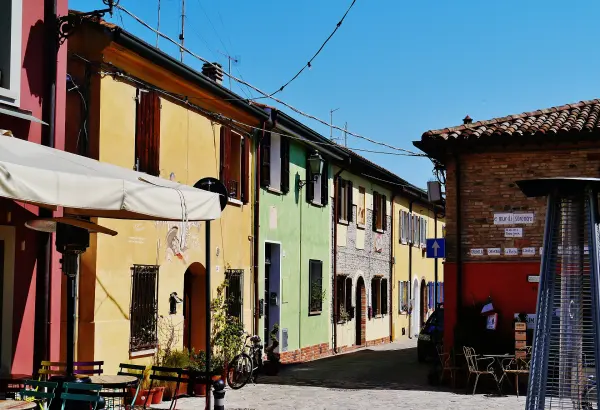
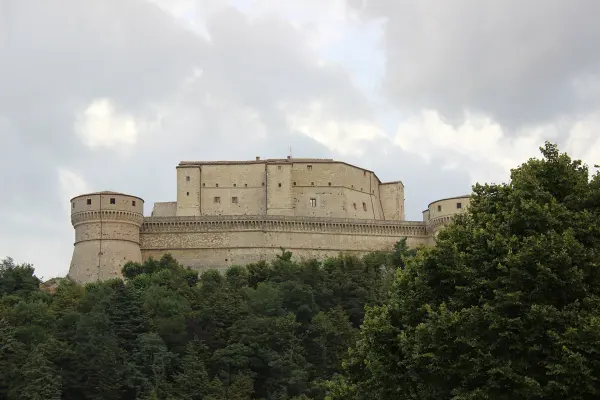
The tufa caves, the Marchi printing workshop with its mangle, the Ganganelli Arch and the castle of the Azzurrina legend.
Santarcangelo is the hillside village closest to the sea: climbing streets, an underground city carved into the tufa and a workshop that still prints fabrics by hand as they did in the 1600s. Then you climb up into the Valmarecchia valley to Montebello Castle, famous for the legend of the little girl Azzurrina. The home of piadina, and of the poets Tonino Guerra and Raffaello Baldini.
Leave Marotta for Santarcangelo di Romagna55 min driving, 75 km
Santarcangelo di Romagna2 h 05 of visits: Piazza Ganganelli and the Arch, The tufa caves, Stamperia Marchi, The upper village and the Rocca Malatestiana
Drive on to Montebello Castle25 min driving, 14 km
Montebello Castle1 h 10 of visits: Montebello Castle and the legend of Azzurrina
Drive back to Marotta1 h 10 driving, 89 km
Back in Marotta
Times are a guide: driving times are worked out without traffic, then come the visits and ten minutes at every stop to park. In summer towards the coast and at rush hour allow extra time.
What you will see
1Santarcangelo di Romagna
Piazza Ganganelli and the Arch 10 min
The main square of the village, with the Sferisterio where they used to play pallone col bracciale. The triumphal arch was built at the end of the 18th century for Lorenzo Ganganelli, born in Santarcangelo and who became Pope under the name of Clement XIV.
The tufa caves 40 min
Under the hill there are more than 150 caves carved into the sandstone: corridors, round rooms, niches and stairs descending into the darkness. It's still not known for certain who carved them or what they were originally for, perhaps places of worship; over the centuries they've been used as cellars, ice houses and shelters during the war. The Grotta Monumentale is the largest and most evocative.
Guided tour, book at the village tourist office (IAT).
Stamperia Marchi 25 min
A workshop opened in 1633 where fabrics are still printed by hand with carved wooden blocks and 'rust' colour, made with vinegar, flour and iron. Inside there's the mangle, an enormous wooden machine for pressing fabrics, with a large wooden wheel turned by hand: they still set it turning for visitors.
It's a shop with workshop: if there are a lot of you, let them know beforehand.
The upper village and the Rocca Malatestiana 20 min
You climb up through narrow streets to the Campanone, the clock tower, from which you can see across the plain to the sea. At the top there's the Rocca dei Malatesta, still privately owned. Along the way you'll find workshops, taverns and verses by dialect poets written on the walls.
The Rocca only opens on certain dates with guided tours.
2Montebello Castle
Montebello Castle and the legend of Azzurrina 50 min
A castle on a rocky spur above the Valmarecchia, inhabited by the Guidi di Bagno family. The guided tour takes you through rooms with furniture and weapons from the Middle Ages to the 18th century and down into the ice house where, according to legend, in 1375 Guendalina disappeared, the albino daughter of the lord of the castle, called Azzurrina for the reflections in her dyed hair. Children love it, and everyone loves the view over the valley.
Guided tours only at set times: check the times and book for groups.
Tips
Santarcangelo has one of the most famous piadinas in Romagna: a stop at a piadineria fits in nicely at the end of your tour.
In July there's the Festival dei teatri in piazza and in November the Fiera di San Martino: the village gets crowded, so a weekday is better.
The same trip from other towns
How long it takes from each town, the drive back included. Tap a town to see the plan from there.
Almost every old town has a limited traffic zone (ZTL) with cameras: park outside and walk in. The fine reaches your home, abroad too. ZTL and car parks town by town
This trip with a driver
Romagna Transfer picks you up at your hotel, drops you in front of every stop and brings you back: no parking, no ZTL, and the wine is yours to enjoy.
Trips written by our editors from the facts of our monument pages and the official sites. Opening days and hours change: the note under every place tells you what to check before you leave. No prices: you find them on the museums' sites.