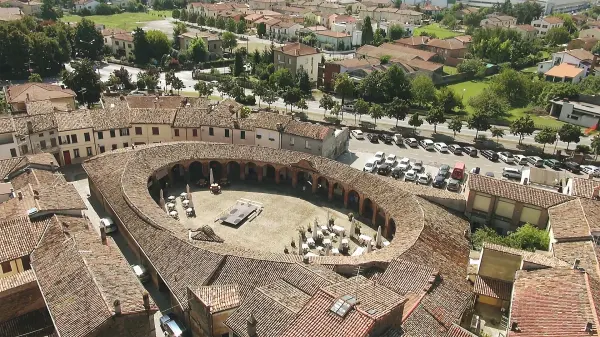
The International Museum of Ceramics, the squares, the Cathedral, Palazzo Milzetti and a ceramicist's workshop.
Faenza is so closely linked to ceramics that in French and English majolica is called 'faïence'. This tour combines the world's most important ceramics museum, the Renaissance town centre and a visit to a workshop where ceramics are still made by hand.
When to goAll year round (the MIC is closed on Mondays)
The plan from Forlì
Leave Forlì for Faenza town centre30 min driving, 19 km
Faenza town centre3 h 30 of visits: MIC, International Museum of Ceramics, Piazza del Popolo and Piazza della Libertà, Cathedral of San Pietro Apostolo, Palazzo Milzetti, Museum of the Neoclassical Age, A ceramicist's workshop
Drive back to Forlì25 min driving, 18 km
Back in Forlì
Times are a guide: driving times are worked out without traffic, then come the visits and ten minutes at every stop to park. In summer towards the coast and at rush hour allow extra time.
What you will see
1Faenza town centre
MIC, International Museum of Ceramics 80 min
Founded in 1908 by Gaetano Ballardini, this is one of the world's largest ceramics collections. It ranges from ancient ceramics of the Middle East, Greek, Roman and pre-Columbian, to Renaissance majolica from Faenza (the 'Faenza white' and grotesque decorations), right up to the 20th century with works by Picasso, Chagall, Matisse, Lucio Fontana and Alberto Burri. You can opt for a shorter visit focused on Faenza and the 20th century.
Closed on Mondays. Separate admission charge.
Piazza del Popolo and Piazza della Libertà 20 min
These two adjoining squares form the heart of the city. In Piazza del Popolo, the Palazzo del Podestà (12th century) and the Palazzo del Municipio, former residence of the Manfredi lords of Faenza, face each other with their double loggias. In Piazza della Libertà you'll find the monumental 17th-century fountain with bronze lions and dragons, and the civic tower, rebuilt after the Second World War.
There's a market in the square on Tuesday, Thursday and Saturday mornings.
Cathedral of San Pietro Apostolo 20 min
Begun in 1474 to a design by the Florentine Giuliano da Maiano, this is one of the great examples of Tuscan Renaissance architecture in Romagna. The façade was left unfinished, in exposed brick, but the interior is harmonious and light. Don't miss the arca of San Savino, sculpted by Benedetto da Maiano.
Free admission, outside service times.
Palazzo Milzetti, Museum of the Neoclassical Age 40 min
One of the finest neoclassical residences in Italy, built between the 18th and 19th centuries for the Milzetti family to a design by Giuseppe Pistocchi. The rooms were painted by Felice Giani and his workshop: myths, deities, faux marble and stucco, all original. It gives you a real sense of what life was like for a noble family in Napoleon's time.
State museum with limited opening hours: check before you set off.
A ceramicist's workshop 20 min
Dozens of craft workshops operate in the town centre, some with a long history, where you can see how a piece is made: the wheel, first firing, glazing, hand decoration. It's also the perfect opportunity to take home an authentic souvenir.
The workshops are private businesses: if there are a lot of you, it's best to give advance notice.
Tips
The MIC is closed on Mondays: on that day choose Brisighella instead.
Faenza and Brisighella are 15 minutes apart: if you want a fuller day out, you can combine them with lunch in the hills.
The same trip from other towns
How long it takes from each town, the drive back included. Tap a town to see the plan from there.
Almost every old town has a limited traffic zone (ZTL) with cameras: park outside and walk in. The fine reaches your home, abroad too. ZTL and car parks town by town
This trip with a driver
Romagna Transfer picks you up at your hotel, drops you in front of every stop and brings you back: no parking, no ZTL, and the wine is yours to enjoy.
Trips written by our editors from the facts of our monument pages and the official sites. Opening days and hours change: the note under every place tells you what to check before you leave. No prices: you find them on the museums' sites.